Setting the environment variable in files like .bash_profile won't work (unless you launch the application from the terminal) because in OSX the applications are not started as in other UNIX'es, they don't inherit the parents shell variables.
Applications like Oracle JDeveloper for mac also don't work by just setting .bash_profile. The only way is to edit /etc/launchd.conf to contain a line like this: "setenv VAR value" and then reboot the system.

Showing posts with label apple. Show all posts
Showing posts with label apple. Show all posts
Sunday, March 1, 2009

Sunday, October 12, 2008
Create a US iTunes Account from South Africa (Or anywhere else)
Many of you might have seen that the South African iTunes don't have any games for the iPhone, not even free ones.. :-( Well you can create a free US account to download them!
Here's how:
1. In iTunes, sign out of any other accounts you have. (By clicking on your account name in the top right corner, and then selecting "Sign Out".
2. Go to the botton of the page, and choose “United States” for the country.
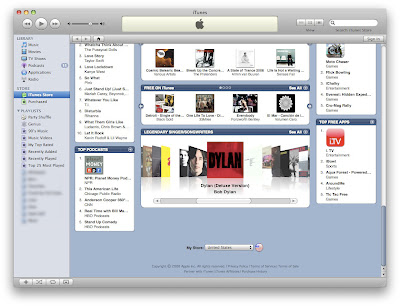
3. Go to any free item to download. (A free game in the appstore will work well). Click "Get App".
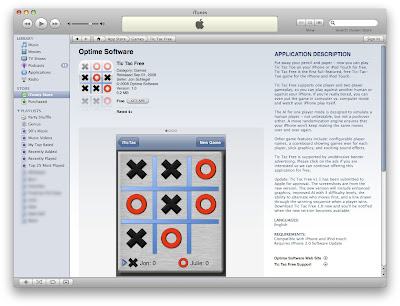
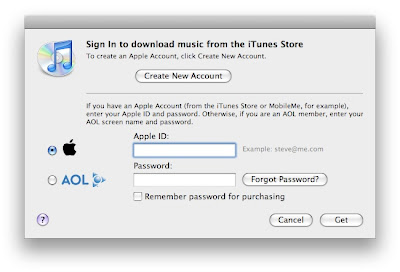
4. When prompted to log in, choose “Create New Account”
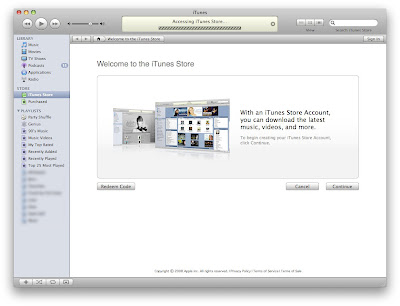
 5. Hit “Continue”
 6. Agree & “Continue”
7. Fill in some details and click “Continue”. Note you'll need a real valid email address.
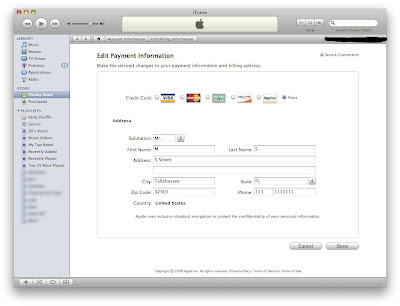
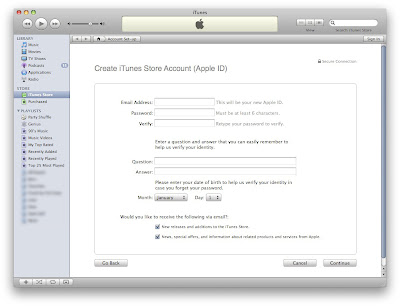 8. Select “None” for payment option, make your state “FL – Florida”, City “Tallahassee”, ZIP Code “32301”. (Put in any other street and telephone number)
9. You will receive a activation email, click on the link and your account will be activated!
Note, you will only be able to download free content. I you want to buy content you will need to buy a iTunes gift certificate. I think you can find some on eBay, or if you live in the Johannesburg area, I saw that WW Computers in Cresta shopping centre sell some.
Happy downloading!
Here's how:
1. In iTunes, sign out of any other accounts you have. (By clicking on your account name in the top right corner, and then selecting "Sign Out".
2. Go to the botton of the page, and choose “United States” for the country.

3. Go to any free item to download. (A free game in the appstore will work well). Click "Get App".

4. When prompted to log in, choose “Create New Account”
 5. Hit “Continue”
 6. Agree & “Continue”
7. Fill in some details and click “Continue”. Note you'll need a real valid email address.
 8. Select “None” for payment option, make your state “FL – Florida”, City “Tallahassee”, ZIP Code “32301”. (Put in any other street and telephone number)
9. You will receive a activation email, click on the link and your account will be activated!
Note, you will only be able to download free content. I you want to buy content you will need to buy a iTunes gift certificate. I think you can find some on eBay, or if you live in the Johannesburg area, I saw that WW Computers in Cresta shopping centre sell some.
Happy downloading!
Monday, August 4, 2008
Connect to a Windows Server VPN from Leopard
Well I had some trouble connecting to a Windows Server VPN with Leopard, and found a very simple solution. I don't know if this will work in all cases, but here goes anyway..
Goto System Preferences -> Network. Then click on the little "+" sign at the bottom left saying Create a new service when you hover the mouse over it. Choose VPN for Interface, and PPTP for VPN Type. Add a New Configuration, type in your Server Address, Account Name (This is your VPN username), and under Authentication Settings your password.
When I did all of this I could connect, but couldn't access anything on the network. The fix was to go to "Advanced" and check the Send all traffic over VPN connection option.

After doing all this you should be able to connect and access the network.
Goto System Preferences -> Network. Then click on the little "+" sign at the bottom left saying Create a new service when you hover the mouse over it. Choose VPN for Interface, and PPTP for VPN Type. Add a New Configuration, type in your Server Address, Account Name (This is your VPN username), and under Authentication Settings your password.
When I did all of this I could connect, but couldn't access anything on the network. The fix was to go to "Advanced" and check the Send all traffic over VPN connection option.

After doing all this you should be able to connect and access the network.
Monday, July 21, 2008
Sqlplus on a Mac with Oracle Instant Client
One of the things any Oracle developer uses is sqlplus, but getting it to work on Mac OS-X is not quite as easy as on Windows. Follow these steps to install sqlplus on your Mac.
1. Download the Oracle Instant Client Zip files:
3. Move the directory to where you want it. I put mine in /usr/local/oracle/instantclient_10_2.
4. Then go to this directory and make symbolic links for dynamic libraries.
5. I reccomend creating a tnsnames.ora file where you add all your connection details. I placed mine in /usr/local/oracle/network/admin.
Example of a tnsnames.ora file:
6. Then you need to set up necessary environment variables. I added mine to my .bash_profile script so they are alway's set when I run the terminal.
In your home folder you can type:
And then add the following lines at the end of the file (Make sure you set the PATH correctly otherwise sqlplus won't run):
7. You should now be able to run sqlplus. Close the terminal and re-lunch it. Now run:
8. Sqlplus should now run and look something like this:

1. Download the Oracle Instant Client Zip files:
- Instant Client Package - Basic
- Instant Client Package - SQL*Plus
- Instant Client Package - JDBC Supplement (Optional)
- Instant Client Package - SDK (Optional)
| unzip instantclient-basic-macosx-10.2.0.4.0.zip unzip instantclient-sqlplus-macosx-10.2.0.4.0.zip unzip instantclient-jdbc-macosx-10.2.0.4.0 #Optional unzip instantclient-sdk-macosx-10.2.0.4.0 #Optional |
3. Move the directory to where you want it. I put mine in /usr/local/oracle/instantclient_10_2.
| sudo mkdir /usr/local/oracle/ sudo mv instantclient_10_2 /usr/local/oracle/ |
4. Then go to this directory and make symbolic links for dynamic libraries.
| sudo ln -s libclntsh.dylib.10.1 libclntsh.dylib sudo ln -s libocci.dylib.10.1 libocci.dylib |
5. I reccomend creating a tnsnames.ora file where you add all your connection details. I placed mine in /usr/local/oracle/network/admin.
Example of a tnsnames.ora file:
| IDENTIFIER = (DESCRIPTION = (ADDRESS_LIST = (ADDRESS = (PROTOCOL = TCP) (HOST = userid.myhosteddb.net)(PORT = 1521)) ) (CONNECT_DATA = (SID = odb)) ) |
6. Then you need to set up necessary environment variables. I added mine to my .bash_profile script so they are alway's set when I run the terminal.
In your home folder you can type:
| vi .bash_profile |
And then add the following lines at the end of the file (Make sure you set the PATH correctly otherwise sqlplus won't run):
| export DYLD_LIBRARY_PATH="/usr/local/oracle/instantclient_10_2" export SQLPATH="/usr/local/oracle/instantclient_10_2" export TNS_ADMIN="/usr/local/oracle/network/admin" export NLS_LANG="AMERICAN_AMERICA.UTF8" export PATH=$PATH:$DYLD_LIBRARY_PATH |
7. You should now be able to run sqlplus. Close the terminal and re-lunch it. Now run:
| sqlplus [username]/[password]@[service] |
8. Sqlplus should now run and look something like this:

Subscribe to:
Posts (Atom)